This article is for informational and educational purposes only and does not constitute personalized financial or investment advice. Information reflects our understanding at the time of publication, but rates, terms, and details discussed may change — always verify current information from official sources before making financial decisions. This post may contain affiliate links; see our affiliate disclosure for details.
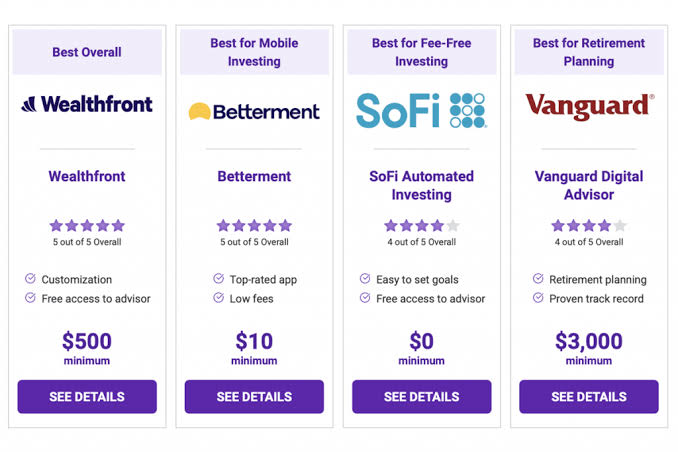
$10,000 isn’t a random number in the robo-advisor world — it sits right at an inflection point. It’s above Schwab Intelligent Portfolios’ $5,000 minimum, but below Fidelity Go’s $25,000 threshold where fees kick in. It’s also below the $25,000 point where Betterment’s tax-loss harvesting becomes most impactful on a taxable account, and well below the $50,000 mark where Schwab finally turns on tax-loss harvesting at all.
In other words, at $10,000, the “best” robo-advisor genuinely depends on account type, tax situation, and what you’re optimizing for — not just which platform has the flashiest marketing. This guide breaks down exactly where $10,000 performs best under real 2026 fee structures, not rounded-up marketing numbers.
Editorial note: This article is for informational and educational purposes only and does not constitute personalized financial, tax, or investment advice. Fees, minimums, and features are subject to change — confirm current terms directly on each provider’s website before opening an account. This post may contain affiliate links; see our [affiliate disclosure] for details.
Quick Verdict
- Best overall for $10,000: Fidelity Go. Management is completely free below $25,000, so your entire $10,000 stays invested with zero advisory fee.
- Best if you want tax-loss harvesting: Betterment or Wealthfront. Both charge 0.25% ($25/year on $10,000) but include automatic tax-loss harvesting on taxable accounts — a feature Schwab doesn’t unlock until $50,000 and Fidelity Go doesn’t offer at all.
- Best if you’re leaning aggressive and want $0 fees with more asset diversity: Schwab Intelligent Portfolios. You clear the $5,000 minimum comfortably, and a smaller cash allocation (aggressive portfolios hold roughly 6%–10% cash) keeps the “cash drag” cost manageable.
Why $10,000 Changes the Calculus
Robo-advisor comparisons usually run the math at $100,000, because that’s where percentage fees really start to bite. But most people opening their first automated account aren’t investing six figures — they’re investing what they’ve actually saved, and $10,000 is a realistic, common starting balance. At that size, three things matter more than they do at $100,000:
- A flat $0 fee is worth relatively more. The difference between 0% and 0.25% is only $25 a year on $10,000 — small in dollar terms, but it’s real money that either compounds in the market or doesn’t.
- Tax-loss harvesting matters less in an IRA and more in a taxable account. If your $10,000 is going into a Roth or Traditional IRA, TLH is irrelevant — gains aren’t taxed annually anyway. If it’s a taxable brokerage account, TLH can meaningfully offset the platform’s fee.
- Minimums that seemed trivial at $100,000 suddenly gate you out. Schwab’s Premium tier needs $25,000. Vanguard’s Personal Advisor Services needs $50,000. At $10,000, you’re firmly in “standard tier, algorithm-only” territory across almost every platform — which is fine, since that’s also where fees are lowest.
Side-by-Side: Cost on a $10,000 Account
| Platform | Fee on $10,000/year | Account minimum | Tax-loss harvesting at $10K? | Cash drag concern |
|---|---|---|---|---|
| Fidelity Go | $0 (free under $25,000) | $10 | No | None |
| Schwab Intelligent Portfolios | $0 advisory fee | $5,000 | No (requires $50,000) | Yes — 6%–30% mandatory cash allocation |
| Vanguard Digital Advisor | ~$15 (0.15% net) | $100 | No | None |
| Betterment | $25 (0.25%) | $0 | Yes, on taxable accounts | None |
| Wealthfront | $25 (0.25%) | $500 | Yes, on taxable accounts | None |
| M1 Finance | $0 (no advisory fee) | $100 | No (self-directed “pies,” not automated) | None |
| SigFig | $0 under $10,000 threshold — check current terms | $2,000 | Varies | None |
Fee figures are illustrative annual costs at exactly $10,000 and assume no promotional pricing. Confirm current numbers before opening an account, since providers change fee schedules and thresholds without much notice.
The Top Contenders, Broken Down
Fidelity Go: The Straightforward Free Option
Fidelity Go doesn’t charge any management fee on balances under $25,000 — full stop. On a $10,000 account, that means every dollar of return is yours; there’s no advisory fee eating into it. Fidelity also builds portfolios using its own Fidelity Flex funds, which carry no expense ratios, so there’s effectively no cost drag on the fund side either.
The tradeoffs: no tax-loss harvesting at any balance, and portfolio customization is limited — you answer a questionnaire and get an allocation, without much ability to tilt toward specific asset classes. For a $10,000 IRA where TLH is irrelevant anyway, this is close to the cleanest option available: genuinely $0, genuinely simple.
Betterment and Wealthfront: Worth the 0.25% If You’re Taxable
Both charge 0.25% annually — $25 a year on $10,000 — but both include automatic tax-loss harvesting on taxable accounts at no extra cost. If you’re investing $10,000 in a regular brokerage account (not an IRA) and expect to hold through market volatility, the tax savings from harvesting losses can offset, or sometimes exceed, that $25 fee over a volatile year. In a flat or steadily rising market, the benefit shrinks — TLH only helps when there are actual losses to harvest.
For an IRA, this advantage disappears, since there’s no capital-gains tax event to offset in the first place. In that case, the 0.25% fee is simply a cost with no offsetting tax benefit, which tilts the math back toward Fidelity Go or Vanguard.
Schwab Intelligent Portfolios: $0 Fee, But Read the Cash Allocation Carefully
Schwab’s $5,000 minimum means $10,000 comfortably qualifies, and the advisory fee is genuinely $0. The catch, covered in detail in our [Schwab vs. Vanguard comparison], is that every Schwab Intelligent Portfolios account holds a mandatory cash allocation — typically 6%–10% for aggressive risk profiles, but as much as 22%–30% for conservative ones. On a $10,000 account with a 10% cash allocation, that’s $1,000 sitting in a Schwab Bank deposit earning a bank savings rate instead of market returns.
If you’re investing aggressively and comfortable with that cash percentage staying low, Schwab is a legitimately strong $0-fee option at this balance. If you’re more conservative, the cash drag can end up costing more in forgone growth than Betterment or Wealthfront’s visible 0.25% fee — worth running the numbers for your specific risk score before choosing.
Vanguard Digital Advisor: The Middle Ground
At roughly 0.15% net annually, Vanguard Digital Advisor costs about $15 a year on $10,000 — cheaper than Betterment or Wealthfront, but not fully free like Fidelity Go or Schwab. What you get in exchange is a simple four-ETF portfolio (VTI, VXUS, BND, BNDX) with no mandatory cash sleeve, so the entire $10,000 stays invested. There’s no tax-loss harvesting at this tier, so the calculus is similar to Fidelity Go: better suited to an IRA than a taxable account where TLH would otherwise add value.
M1 Finance: Free, But Not Quite “Set and Forget”
M1 Finance charges no advisory fee at any balance, which sounds like an easy win at $10,000. The caveat is that M1 isn’t a traditional robo-advisor — it’s a self-directed “pie” investing platform where automated rebalancing happens within an allocation you build yourself, rather than one generated and managed by an algorithm based on a risk questionnaire. For someone who wants true hands-off automation, that extra setup step matters. For someone comfortable choosing their own fund mix once and then automating from there, M1 can be a genuinely $0-cost option.
Taxable Account vs. IRA: The Decision That Matters Most
Before comparing platforms, decide where the $10,000 is actually going, because it changes the “best” answer more than any fee difference does:
If it’s going into a Roth or Traditional IRA: tax-loss harvesting provides no benefit, since gains inside an IRA aren’t taxed annually either way. This tilts the decision toward the lowest-cost options — Fidelity Go ($0) or Vanguard Digital Advisor (~$15/year) — since you’re not giving up anything by skipping Betterment or Wealthfront’s TLH feature.
If it’s going into a taxable brokerage account: tax-loss harvesting has real potential value, particularly in a volatile year. Betterment or Wealthfront’s 0.25% fee becomes easier to justify, since the harvested losses can offset gains elsewhere in your portfolio and reduce your tax bill.
A Simple Framework for Choosing
- Want the simplest, cheapest possible option and don’t need TLH? → Fidelity Go
- Investing in a taxable account and expect market volatility? → Betterment or Wealthfront
- Comfortable with an aggressive risk profile and want broad diversification at $0 fee? → Schwab Intelligent Portfolios
- Want a simple, low-cost, fully-invested portfolio with Vanguard’s index philosophy? → Vanguard Digital Advisor
- Willing to build your own allocation once and automate from there? → M1 Finance
What Changes as Your Balance Grows Past $10,000
It’s worth knowing what’s waiting on the other side of $10,000, since these thresholds will eventually matter:
- $25,000: Fidelity Go starts charging 0.35%. Schwab’s Premium tier (CFP access) becomes available.
- $50,000: Schwab Intelligent Portfolios finally turns on tax-loss harvesting. Vanguard’s Personal Advisor Services (human CFP access) becomes available at 0.30%.
- $100,000: Wealthfront unlocks direct indexing, a more granular form of tax-loss harvesting at the individual-stock level.
None of these thresholds should drive your decision today at $10,000 — but they’re worth knowing so a platform choice made now doesn’t box you out of a feature you’ll actually want later.
Our Methodology
This comparison is based on publicly available fee schedules, account minimums, and feature disclosures published by each provider as of 2026. Cost figures at $10,000 are calculated directly from each platform’s published percentage fee or flat-fee structure; cash drag estimates for Schwab are illustrative and depend on your individual risk score and prevailing bank sweep rates. We do not maintain active investment accounts with every platform covered here for this specific comparison — treat this article as a starting point for your own research, and confirm current terms directly with each provider before opening an account.
Frequently Asked Questions
Is $10,000 enough to open a robo-advisor account? Yes. Most major robo-advisors have minimums well below $10,000 — Fidelity Go requires just $10, Vanguard Digital Advisor requires $100, and even Schwab Intelligent Portfolios’ $5,000 minimum leaves comfortable room.
Does tax-loss harvesting matter for a $10,000 account? Only in a taxable brokerage account. In an IRA, gains aren’t taxed annually, so tax-loss harvesting provides no benefit regardless of balance.
Is a $0-fee robo-advisor always cheaper than one that charges 0.25%? Not necessarily. Schwab’s $0 fee comes with a mandatory cash allocation that isn’t invested in the market — depending on your risk profile, that “cash drag” can cost more in forgone growth than a visible 0.25% fee elsewhere.
Should I split $10,000 across two robo-advisors instead of picking one? It’s possible, but it adds complexity — two logins, two rebalancing schedules, and potentially two sets of minimums to track. For a “set and forget” strategy, one platform matched to your account type (taxable vs. IRA) is usually simpler and just as effective.