This article is for informational and educational purposes only and does not constitute personalized financial or investment advice. Information reflects our understanding at the time of publication, but rates, terms, and details discussed may change — always verify current information from official sources before making financial decisions. This post may contain affiliate links; see our affiliate disclosure for details.
Rebalancing sounds simple.
If stocks rise and become too large a share of your portfolio, you sell some stocks and buy other assets. If bonds fall below their target allocation, you buy more bonds.
In theory, the process is straightforward.
In practice, many investors struggle to do it consistently.
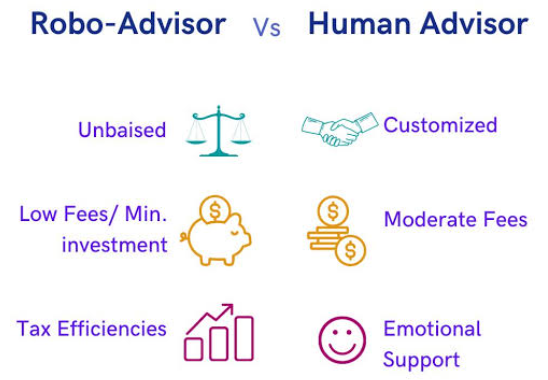
That is one of the biggest selling points of robo-advisors. Automated platforms can monitor a portfolio, identify when asset allocations move away from their targets, and execute trades without the investor having to make a decision.
But does automation actually produce better rebalancing?
Or is the robo-advisor simply doing something a disciplined investor could do manually in a few minutes?
The answer depends on what “better” means.
What Rebalancing Is Actually Designed to Do
Rebalancing is not primarily a strategy for predicting the market.
It is a risk-management process.
Imagine an investor begins with a portfolio allocated 60% to stocks and 40% to bonds. After a strong stock-market rally, stocks rise to 70% of the portfolio.
The investor now has more exposure to stocks than originally intended.
If the market continues rising, that decision may appear to have been profitable. But if stocks subsequently fall sharply, the investor may experience more volatility than originally planned.
Rebalancing brings the portfolio back toward its intended risk profile.
That is the key point: rebalancing is about maintaining a strategy, not predicting the next market move.
Why Humans Are Often Bad at Rebalancing
The biggest advantage of a robo-advisor may not be superior mathematics.
It may be behavioral discipline.
Investors often have strong emotional reactions to market movements. When stocks have risen significantly, selling some of the winners can feel irrational. When an asset class has fallen sharply, buying more can feel dangerous.
Yet those are precisely the actions that a traditional rebalancing strategy may require.
This creates a psychological problem.
Investors may say they want a 60/40 portfolio, but when the portfolio drifts to 70/30 after a market rally, they may decide to leave it alone because “stocks are doing well.”
Then, after a market crash, they may hesitate to buy stocks because “the market could fall further.”
The result is a portfolio that slowly changes its risk profile based on emotion.
A robo-advisor does not experience fear, excitement, or regret. It does not care whether the asset it is selling has recently outperformed.
If the portfolio has crossed its rebalancing threshold, the system can act.
That consistency is a genuine advantage.
Automation Does Not Necessarily Mean Constant Trading
One misconception is that a robo-advisor is constantly buying and selling.
Most automated platforms do not rebalance every time an allocation moves by a tiny amount. Excessive trading can create unnecessary costs and tax consequences.
Instead, robo-advisors typically use rules or thresholds.
For example, the system may allow an asset allocation to drift by a certain amount before making adjustments. Some platforms may also use scheduled rebalancing or combine rebalancing with new deposits and withdrawals.
This is important because the best rebalancing system is not necessarily the one that trades most frequently.
It is the one that maintains the desired risk exposure without creating unnecessary turnover.
The Tax Question Makes the Comparison More Complicated
A human investor rebalancing inside a taxable brokerage account may trigger capital gains taxes.
A robo-advisor faces the same basic tax reality.
Automation does not eliminate tax consequences.
However, some automated platforms can incorporate tax-aware techniques into their portfolio management. These may include using new contributions to purchase underweighted assets or employing tax-loss harvesting where appropriate.
This can make automated management more sophisticated than simply selling whatever has grown the most.
But tax management is highly dependent on the account type, the investor’s tax situation, and the specific platform.
An investor should not assume that every automated rebalance is automatically tax-efficient.
The Human Investor Has One Major Advantage: Context
Robo-advisors are good at following rules.
Humans are better at understanding circumstances.
Suppose an investor is five years away from purchasing a home. Or perhaps their income has suddenly fallen. Maybe they have received a large inheritance or expect a major tax bill.
Those events may justify changing the investment strategy itself.
A robo-advisor may continue rebalancing toward the existing target allocation unless the investor updates the information driving the portfolio.
This creates a critical distinction:
Rebalancing a portfolio is not the same thing as deciding whether the portfolio is still appropriate.
A robo-advisor may be excellent at maintaining a 60/40 allocation. But it cannot automatically know that the investor’s financial circumstances have changed unless the relevant information is provided.
The human investor still has to make strategic decisions.
Is More Frequent Rebalancing Better?
Not necessarily.
There is no universal rule that says rebalancing more frequently produces better investment results.
More frequent trading can increase transaction costs, create tax events, and potentially cause an investor to react too aggressively to normal market fluctuations.
A system that waits for meaningful deviations may be more efficient than one that constantly tries to restore the exact target allocation.
The optimal approach depends on the portfolio, account type, investment costs, tax considerations, and the investor’s objectives.
In many cases, the biggest benefit of automation is not precision down to the last percentage point.
It is simply making sure that rebalancing actually happens.
The Real Test: Could You Do It Yourself?
For a disciplined investor, the answer may be yes.
An individual can establish target allocations, set rebalancing rules, review the portfolio periodically, and make the necessary trades.
The mechanics are not especially complicated.
The challenge is behavioral.
Would you sell a portion of your best-performing asset after a long rally?
Would you buy more of an asset class that has fallen 30%?
Would you follow your plan during a financial crisis?
If the honest answer is no, then automation may provide significant value.
The robo-advisor is not necessarily making a more intelligent decision. It is helping prevent the investor from abandoning a reasonable decision.
The Verdict: Robo-Advisors May Rebalance More Consistently, Not Magically
Robo-advisors do not possess a secret formula that guarantees superior rebalancing results.
Their advantage is more practical.
They can monitor portfolios continuously, apply predetermined rules, reduce the need for manual intervention, and remove some of the emotional pressure associated with buying and selling.
That can make them better rebalancing machines than most individual investors.
But the system is only as good as the strategy behind it.
A robo-advisor cannot compensate for an inappropriate asset allocation, unrealistic risk tolerance, excessive fees, or outdated financial goals.
The best automated platform in the world cannot fix a portfolio that was poorly designed in the first place.
The most accurate conclusion is therefore this: robo-advisors may not rebalance smarter than you, but they may rebalance more reliably than you do.
For investors who are highly disciplined and comfortable managing their own portfolios, manual rebalancing may be perfectly adequate.
For everyone else, the value of autopilot may be less about superior intelligence and more about removing the investor from the moment when discipline is hardest.
And in investing, consistently following a reasonable plan is often more valuable than occasionally making a brilliant decision.
This article is for educational purposes only and is not investment advice. Market projections and statistics reflect industry research as of 2026 and are subject to change.