Fees, minimums, and conditions in this guide were checked against current provider and third-party sources in 2026. They change often, so confirm them on each provider’s website before opening an account.
When I started using robo-advisors, I wasn’t looking for a sophisticated way to invest. I wanted something much simpler: a way to invest in a diversified, automated, low-friction manner, without constantly making decisions that could end up hurting my own portfolio.
After five years of using each of the four robo-advisors I’ve tried (Wealthfront, Vanguard, Betterment, and Schwab Intelligent Portfolios), I have a pretty clear sense of their main appeal: they automate a good part of the work that managing a portfolio on your own normally requires.
That doesn’t mean a robo-advisor eliminates investment risk, or that they all work exactly the same way. Fees, minimums, customization, customer service, tax management, and the way portfolios are built can vary quite a bit.
In this guide, I’ll explain what a robo-advisor is, how it works, how much it costs, what its advantages and limitations are, and, above all, what I consider important after using these platforms for years. I also explain what my return figures do and don’t represent, and I finish with a side-by-side comparison table.
What Is a Robo-Advisor?
A robo-advisor is an automated investing service that uses algorithms to build and manage a portfolio based on certain investor parameters.
Instead of choosing each investment manually, you typically enter information about your goals, time horizon, and risk tolerance. Based on that information, the system determines an asset allocation and manages the portfolio following a predefined strategy.
The core idea is simple: automate a good portion of the investment decisions.
In a traditional, self-managed portfolio, you have to decide how much to invest, which assets to buy, when to rebalance, and, depending on the account and strategy, which positions to sell or hold.
With a robo-advisor, much of that work is automated.
This was precisely one of the reasons I started using them. For me, the benefit wasn’t just saving time. It was also reducing the risk of behavioral mistakes.
When you manage your own investments, it’s easy to make impulsive decisions after a market drop, delay a contribution because the market looks expensive, or change your portfolio because one investment is performing worse than expected.
An automated system doesn’t eliminate an investor’s emotions, but it can reduce the number of decisions the investor has to make.
How a Robo-Advisor Works
The process usually begins with a questionnaire designed to determine your investor profile.
Depending on the platform, it may ask about things like your goals, time horizon, risk tolerance, or financial situation.
Using that information, the robo-advisor builds a diversified portfolio.
From there, the platform can handle tasks such as:
- investing your contributions;
- maintaining your asset allocation;
- rebalancing the portfolio;
- automating certain transactions;
- applying tax-efficiency strategies where available;
- making it easier to track your portfolio.
The main difference compared to investing entirely on your own is, therefore, the level of automation.
You don’t have to become an expert in asset selection to start applying a diversified strategy.
What Types of Investments Does It Use?
Robo-advisors can use different types of assets, although automated portfolios are usually built around a diversified mix of asset classes.
Among the concepts that commonly come up are:
- stocks;
- bonds;
- ETFs;
- funds;
- fixed income;
- different geographic and sector categories.
The proportion of each asset depends on the strategy and the risk profile.
A portfolio designed for an investor with a long time horizon and a higher risk tolerance may have a different exposure than one for someone looking for a more conservative portfolio.
That’s why it doesn’t make much sense to talk about a robo-advisor’s returns without also specifying which portfolio, which period, and which level of risk we’re comparing.
Robo-Advisor vs. Traditional Financial Advisor
The main difference is the degree of automation and personalization.
A human financial advisor can analyze your particular circumstances and have conversations with you to tailor the strategy to situations that may not fit easily into an algorithm.
A robo-advisor, on the other hand, aims to standardize and automate a significant part of the process.
That can be especially appealing for someone who wants to invest for the long term without spending a considerable amount of time managing a portfolio.
In my case, that combination of automation, diversification, and low effort was one of the main reasons I used them.
How Does a Robo-Advisor Invest Your Money?
A robo-advisor isn’t simply a matter of depositing money into an account and letting an algorithm pick stocks at random.
The logic starts with an asset allocation strategy.
First, it determines which mix of assets may fit the investor’s profile. Then it builds and maintains the portfolio according to that allocation.
Risk Profile and Investment Goals
Risk is one of the fundamental variables.
Investing money you’ll need soon is not the same as investing for a goal several decades away.
That’s why robo-advisors typically try to link your time horizon and risk tolerance to a particular asset allocation.
I find this point especially important for beginning investors: a robo-advisor doesn’t turn a risky investment into a safe one.
What it does is help you apply a strategy that’s consistent with the parameters you provided.
Diversification and Asset Allocation
One of the reasons I started using robo-advisors was precisely diversification.
Instead of having to manually select dozens or hundreds of positions, an automated portfolio can provide exposure to different assets and markets following a set allocation.
For me, being able to get that diversification from day one with little effort is one of the model’s strengths.
That said, diversification doesn’t mean eliminating losses.
A diversified portfolio can fall when the market falls. Diversification aims to spread risk across different investments and does not guarantee a positive outcome.
Automatic Portfolio Rebalancing
Over time, the assets in a portfolio don’t necessarily keep the same weight.
Imagine a portfolio that starts with a certain split between stocks and bonds. If stocks rise significantly, their weight can end up exceeding the original target.
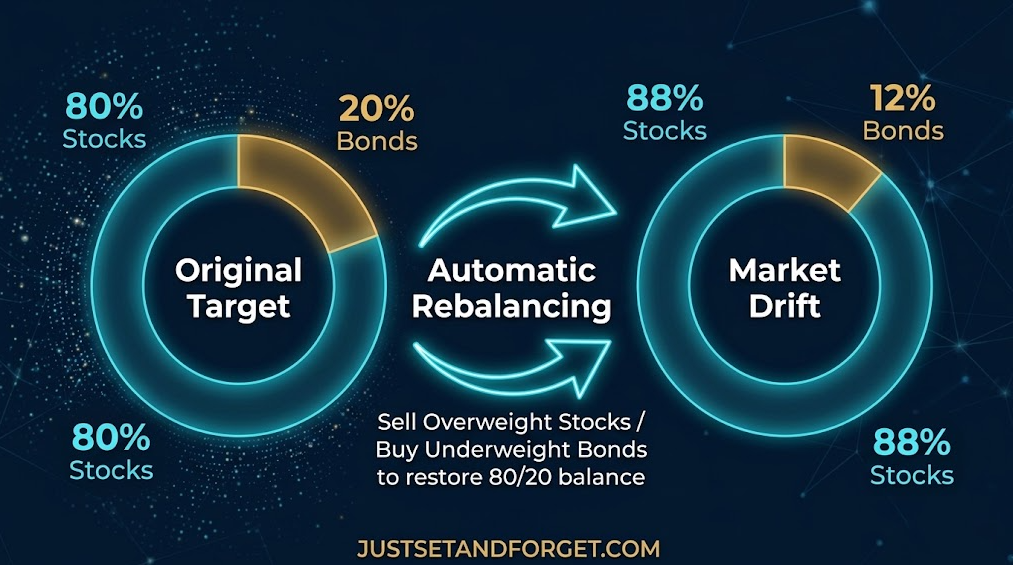
Rebalancing tries to bring the portfolio back to its target allocation.
This is another practical advantage I found after using these services for years: I don’t have to constantly keep an eye on whether my portfolio has drifted from its target allocation.
The system automates a task that, if you managed a portfolio on your own, you’d have to monitor yourself.
Recurring Contributions and Automation
Automation doesn’t stop at rebalancing.
You can also set up recurring contributions to maintain investing discipline.
For me, this combination is especially appealing:
automatic contributions + diversified portfolio + automatic rebalancing + low effort.
The fewer unnecessary decisions you have to make, the easier it is to stick with a strategy for years.
And in long-term investing, sticking with a strategy can be just as important as designing it in the first place.
How Much Does a Robo-Advisor Cost?
Fees are one of the things I pay the most attention to when evaluating a robo-advisor.
A seemingly small difference can matter when it’s applied to a portfolio over many years.
Two of the platforms I’ve used, Wealthfront and Betterment, charge a standard advisory fee of 0.25% per year. Vanguard Digital Advisor has a lower net advisory fee of roughly 0.15%, and Vanguard Personal Advisor, which adds access to a human planner, is roughly 0.30%.
Schwab Intelligent Portfolios has a different structure: it doesn’t charge an advisory fee. As I explain below, that “free” label comes with a significant trade-off.
But comparing only the advisory fee can lead to incomplete conclusions.
Management Fees
The first number to look at is the fee the robo-advisor charges to manage or advise on the portfolio.
But you also need to check the costs associated with the investments that make up that portfolio.
That’s why, before signing up for a service, I wouldn’t settle for just the headline of “0.25% fee” or “no advisory fee.”
You have to understand what you’re really paying for.
Other Costs to Keep in Mind
In addition to the management fee, it’s worth reviewing:
- fund or ETF expense ratios;
- possible costs associated with certain transactions;
- balance requirements;
- monthly fees;
- conditions for accessing certain features.
The fee structure can change over time, so current rates should be checked directly before opening an account.
Why a Small Fee Matters in the Long Run
The problem with fees is that you don’t pay them just once.
They’re applied to your assets under management, and over long periods they can add up to a significant amount.
That’s why I consider the combination of low cost and automation to be one of the most interesting features of robo-advisors.
The key is not to confuse low cost with zero cost. And you also shouldn’t assume that the service with the lowest fee is necessarily the best fit for every investor.
Advantages of Using a Robo-Advisor
After using four platforms for five years each, there are several features I consider especially relevant.
Investing With Little Effort
This is probably the advantage I value most.
I don’t mean that investing is easy or that you don’t need to understand what you’re doing. Quite the opposite: I believe you have to understand where your money is and what risks you’re taking on.
But once the strategy is defined, I don’t see much value in having to step in constantly.
The robo-advisor can handle much of the execution and maintenance of the portfolio.
That reduces friction.
Diversification From the Start
Another advantage is being able to start with a diversified portfolio without having to build it position by position.
For someone just starting out, this can significantly reduce the learning curve.
You don’t need to individually decide which stocks to buy to get exposure to different segments of the market.
Avoiding Behavioral Mistakes
This is a particularly important reason for me.
An investment strategy can be excellent on paper and still fail if the investor keeps changing course.
Buying after a rally, selling after a drop, or changing your portfolio every time market sentiment shifts can end up being counterproductive.
A robo-advisor adds a layer of automation that can help reduce those impulsive decisions.
It doesn’t eliminate emotions, because you’re still the one who decides whether to hold or withdraw your money, but it does reduce the number of decisions you need to make day to day.
Automated Investing and Rebalancing
Recurring contributions and automatic rebalancing complete the system.
In my case, this automation is exactly what makes the model so convenient.
I don’t need to manually remember each transaction or continually check whether the portfolio still has the allocation I set.
Tax Optimization Through Tax-Loss Harvesting
Another feature I find interesting is tax-loss harvesting.
The general idea is to use losses on certain investments to offset gains for tax purposes, within the applicable tax rules.
In my experience, Betterment and Wealthfront have offered this feature in taxable accounts.
Wealthfront also offers US Direct Indexing, in which the portfolio holds individual stocks instead of a single total-market ETF in order to harvest losses at the stock level. It’s available within the standard Wealthfront portfolio for accounts of $100,000 or more, at no cost beyond the regular 0.25% advisory fee. Separately, Wealthfront’s standalone S&P 500 Direct and Nasdaq-100 Direct products require a $5,000 minimum.
These features can be valuable, but they shouldn’t be mistaken for a guarantee of tax savings. The actual benefit depends on each investor’s tax situation and the applicable rules.
Disadvantages and Risks of Robo-Advisors
A robo-advisor is not a magic solution.
Precisely because I’ve used them for years, I think it’s important to also talk about what I don’t like about the model.
They Don’t Eliminate Investment Risk
This should be the first warning.
A robo-advisor can automate a portfolio, but it can’t guarantee that you won’t lose money.
If the portfolio has exposure to assets that fall, the value of the account can decline.
Automation also doesn’t predict the market.
What it does is apply a particular strategy systematically.
Less Personalization Than a Human Advisor
Automation has a trade-off: it can limit personalization.
Purely automated services, such as Wealthfront or Vanguard Digital Advisor, don’t give you access to a human advisor. At Vanguard, human advice comes with the separate Personal Advisor service, which has a much higher minimum.
For an investor with a simple financial situation, this may not be a problem.
But the more complex your financial situation, the more important it can be to talk to a person and explain circumstances that a questionnaire can’t always fully capture.
Minimums and Costs
Not all robo-advisors have the same barriers to entry.
On the platforms I’ve used, for example, the minimums are $500 at Wealthfront, $5,000 at Schwab, and $50,000 at Vanguard Personal Advisor (Vanguard’s fully automated Digital Advisor requires only $100).
Betterment, on the other hand, is more accessible because it doesn’t require a minimum balance.
And here’s an interesting detail: a seemingly small cost structure can weigh heavily on a small portfolio.
At Betterment, for example, if your balance is under $24,000 and you don’t have at least $200 per month in recurring deposits, you pay a flat $5 per month instead of 0.25% per year. That’s $60 a year, which is 6% of a $1,000 balance and 3% of a $2,000 balance, compared with 0.25% under the percentage-based plan. On a small balance, that amount represents a much higher effective percentage.
That’s why I recommend always looking at the cost both in dollars and as a percentage of your assets.
The Problem of Holding Too Much Cash
This is one of the things I like least about Schwab Intelligent Portfolios.
The large mandatory cash allocation can reduce market exposure and, depending on the environment, drag on returns compared to a portfolio with a different allocation.
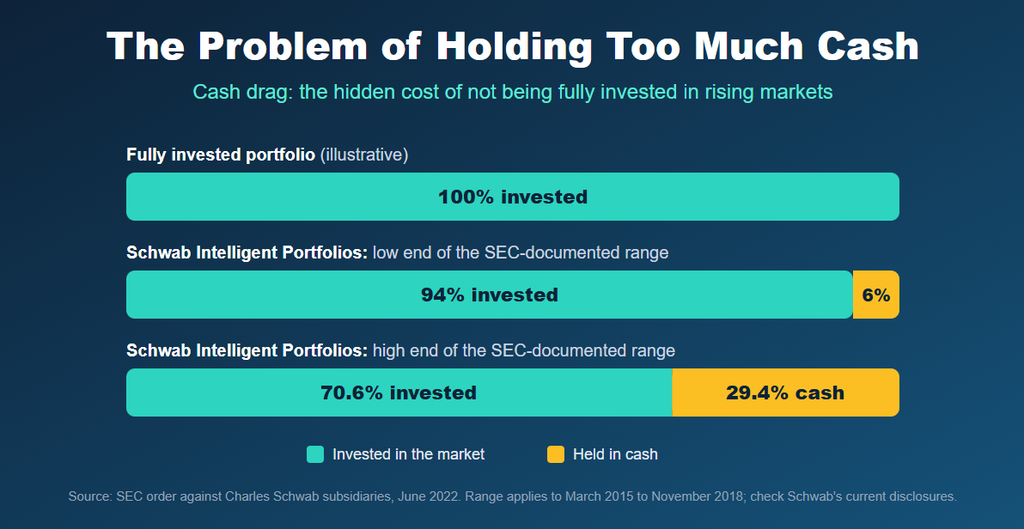
In 2022, Schwab’s advisory subsidiaries agreed to pay $187 million to settle SEC charges over how they disclosed the cash allocation in this program. The SEC said that from March 2015 through November 2018 the portfolios held between 6% and 29.4% of client assets in cash, and that Schwab’s own analysis showed this would produce lower returns for clients in most market conditions. The settlement consisted of a $135 million civil penalty plus $52 million in disgorgement and interest, and Schwab neither admitted nor denied the findings. This is part of the context I think is important to know when evaluating the service.
That said, it’s worth clearly distinguishing between a specific regulatory issue and the overall evaluation of a platform. The settlement concerned a defined past period, and current cash allocations and disclosures should be checked directly with Schwab.
My Experience Using Four Robo-Advisors for 5 Years
My experience with robo-advisors isn’t limited to having opened an account to try out an app for a few weeks.
I’ve used each of the four services I mention for five years: Wealthfront, Vanguard, Betterment, and Schwab Intelligent Portfolios.
That has allowed me to look beyond the interface or the sign-up process and focus on what matters much more when a portfolio stays invested for years: costs, automation, rebalancing, customer service, taxes, and friction.
About My Return Figures
Return figures are easy to misread, so here is what the numbers in this guide are, and what they are not.
- What they are: For each platform, the return I recorded from my own experience over five years of using it. They are personal records, not projections, and they are not audited.
- Different portfolios: Each platform builds its own portfolio, so these are not results from identical strategies. At Wealthfront I record two results because I used two versions of its portfolio: the 2016 version (7.56%) and the 2018 version (7.10%). At Vanguard, the figure belongs to the specific service named in that section.
- What I’m not claiming: I don’t present these figures as measured on a common basis, meaning the same period, risk level, contributions, or tax treatment. I also don’t claim they are net of fees or taxes, so they shouldn’t be compared directly with each other or with returns advertised by providers.
- Where to find standardized numbers: For official performance data, use each provider’s own published performance and disclosures.
Past performance does not guarantee future results. These figures are not a forecast, and I don’t use them to claim that one platform is better than another. Compare platforms on fees, minimums, and features instead.
Wealthfront: 5 Years of Use
Wealthfront is one of the services I have the most experience with.
In my case, I recorded 7.56% on the 2016 version of the portfolio and 7.10% on the 2018 version (see “About My Return Figures” above).
These figures reflect my own experience and should not be interpreted as an expected return for other investors.
One of the things I value most about Wealthfront is the combination of automation, diversification, and tax tools.
I also find US Direct Indexing interesting, although it only applies to accounts of $100,000 or more.
Its main drawback for me is the $500 entry minimum. It also has no human advisors, and support is limited to weekdays.
Vanguard Personal Advisor: 5 Years of Use
With Vanguard Personal Advisor, I recorded 7.19% in my experience.
What I value most is that it adds access to a human planner on top of a managed portfolio, for a net advisory fee of roughly 0.30%. The main barrier is the $50,000 minimum.
It’s an important distinction: automating a portfolio and receiving personalized financial advice are not exactly the same thing.
Betterment: 5 Years of Use
My five years with Betterment produced a 6.67% return.
One of the things I value most is its ease of use and automation.
Its tax optimization through tax-loss harvesting in taxable accounts also stands out for me.
However, you need to pay attention to its cost structure when your balance is small.
As I mentioned earlier, paying $5 a month on a small account can represent a considerable share of your assets if you don’t meet the balance ($24,000) or recurring deposit ($200 per month) thresholds that switch you to the 0.25% fee.
It’s a good example of why it’s not enough to look at the advertised fee: you have to calculate how much you’ll actually pay based on your balance.
Schwab Intelligent Portfolios: 5 Years of Use
With Schwab Intelligent Portfolios, I recorded 6.54%.
One of the features I value most is customer service.
For me, having access to an organization that can respond when a question comes up can be an important factor.
However, cash is one of the things I like least.
The mandatory cash allocation can keep part of the portfolio out of the market, which can carry an opportunity cost when other assets are rising.
I also encountered an entry minimum of $5,000, higher than that of some alternatives.
What Should You Look at Before Choosing a Robo-Advisor?
After using several of them for years, I wouldn’t choose a robo-advisor by looking only at who has the lowest fee.
Several factors should go into the comparison.
Fees
First, I’d look at how much it really costs to maintain the account.
Not just the advisory fee, but also the expenses of the underlying products and any flat fees.
Minimum Investment
Next, I’d check how much money you need to get started.
A platform may look appealing, but if it requires an initial balance you don’t have, its features are irrelevant to your situation.
Portfolio Customization
I’d ask how much you can tailor the strategy.
Can you choose different goals? Adjust the risk level? Access certain strategies?
The more customization you want, the more important this point becomes.
Customer Service and Human Advice
I’d also check what happens when you need help.
Is there customer service? Can you talk to a professional? Is it purely an automated system?
In my experience, Schwab’s customer service is one of the things I value most.
Automation and Rebalancing
This is one of the main reasons to use a robo-advisor.
If you’re going to pay for automation, make sure you understand which tasks the platform actually performs.
Tax Optimization
If you invest in a taxable account, I’d check what tax tools it offers.
Tax-loss harvesting can be worthwhile, but its usefulness depends on your specific situation.
Who Does a Robo-Advisor Make Sense For?
I don’t think there’s a single user profile.
But there are certain situations where automation can be especially useful.
Beginning Investors
For someone just starting out, a robo-advisor can reduce the number of decisions they have to make.
Instead of immediately learning to pick individual investments, they can start with a diversified, automated strategy.
That doesn’t mean they shouldn’t learn.
In fact, I believe understanding what you’re buying, what risk you’re taking, and how much you’re paying is essential.
But you can learn while keeping a relatively simple strategy in place.
People Who Want to Invest Automatically
This is probably the profile I identify with most.
If you want to make regular contributions and avoid making decisions constantly, automation can be a considerable advantage.
Investors Seeking a Long-Term Strategy
Robo-advisors fit especially well with a long-term mindset.
The reason isn’t that they can predict what will happen in the market.
It’s that they make it easier to apply a strategy consistently: invest, diversify, rebalance, and stick with the plan.
When It Might Make Sense to Look for a Human Advisor
There are situations where a robo-advisor can fall short.
If you have a complex financial situation, particular tax needs, multiple sources of income, estate planning needs, or goals that require personalized analysis, you may need more than an algorithm.
The point isn’t that one option is universally better than the other.
The question is how much personalization and guidance you need.
Frequently Asked Questions About Robo-Advisors
Is It Safe to Invest With a Robo-Advisor?
The security of the platform and the risk of the investments are two different matters.
A robo-advisor may use security systems and operate within the applicable regulatory framework, but that doesn’t mean the value of your investments is guaranteed.
You should always check who manages the account, which institution holds the assets, and what protection applies.
What Returns Does a Robo-Advisor Earn?
There’s no single return.
It depends on the portfolio, the asset allocation, the period analyzed, costs, and market conditions.
Here are the figures I recorded over five years on the platforms I’ve used. Please read them together with “About My Return Figures” above.
- Wealthfront, 2016 portfolio: 7.56%.
- Wealthfront, 2018 portfolio: 7.10%.
- Vanguard Personal Advisor: 7.19%.
- Betterment: 6.67%.
- Schwab Intelligent Portfolios: 6.54%.
These figures come from my own experience and are neither a prediction nor a guarantee for future investors.
Can You Lose Money With a Robo-Advisor?
Yes.
A robo-advisor doesn’t eliminate market risk.
Automation can help you stick with a strategy, but it can’t prevent the assets in the portfolio from losing value.
How Much Money Do I Need to Get Started?
It depends on the platform.
Betterment has no minimum balance. Vanguard Digital Advisor requires $100, Wealthfront $500, and Schwab Intelligent Portfolios $5,000. Vanguard Personal Advisor, the version with human advisors, requires $50,000.
Since requirements can change, it’s worth checking them before opening an account.
Can I Withdraw My Money Whenever I Want?
The terms depend on the platform, the type of account, and your tax situation.
In addition, selling investments can have tax consequences in certain types of accounts.
That’s why I wouldn’t treat an investment portfolio like a checking account: before investing money, you need to be clear about your time horizon and the liquidity you need.
Is a Robo-Advisor Worth It?
The question I’d ask myself isn’t simply whether it’s “worth it.”
I’d ask myself:
How much value do I place on automating my investing, diversifying, rebalancing, and reducing the number of decisions I have to make?
In my case, after five years of using each of these platforms, that automation is precisely one of the reasons I still find the model appealing.
The value isn’t just in the algorithm.
It’s in making a reasonable strategy easy to execute and stick with.
Comparison at a Glance
| Wealthfront | Betterment | Vanguard Digital Advisor | Vanguard Personal Advisor | Schwab Intelligent Portfolios | |
|---|---|---|---|---|---|
| Advisory fee | 0.25% | 0.25%, or $5/month if under $24,000 and under $200/month in recurring deposits | ~0.15% net | ~0.30% net | $0 (with a cash allocation trade-off) |
| Minimum | $500 | $0 | $100 | $50,000 | $5,000 |
| Automation | Automatic investing and rebalancing | Automatic investing, rebalancing, and reinvesting | Automatic investing and daily rebalancing checks | Same as Digital Advisor, plus a human planner | Automatic rebalancing |
| Tax tools | Tax-loss harvesting; US Direct Indexing at $100,000+ | Tax-loss harvesting in taxable accounts | Check current terms | Check current terms | Check current terms |
| Customer service | No human advisors; weekday support | Email support; access to CFPs only on Premium (0.65%, $100,000 minimum) | No human advisors | Access to a human planner | Strong in my experience |
| My 5-year result | 7.56% (2016 portfolio) / 7.10% (2018 portfolio) | 6.67% | Not used | 7.19% | 6.54% |
Fees and minimums checked in 2026. My results are personal, come from different portfolios and possibly different periods, and are not a ranking. See “About My Return Figures” above.
Conclusion: What You Should Know Before Investing With a Robo-Advisor
To me, a robo-advisor is, above all, a tool for simplifying long-term investing.
It doesn’t replace a basic understanding of the markets, it doesn’t eliminate risk, and it doesn’t guarantee any particular return.
Its main appeal lies in combining several tasks that you’d otherwise have to do yourself:
diversifying, investing regularly, maintaining an asset allocation, rebalancing, and, in some cases, applying tax optimization strategies.
After five years of using Wealthfront, Vanguard, Betterment, and Schwab Intelligent Portfolios, I’m also clear that the differences between platforms matter.
I wouldn’t look only at the fee.
I’d check the entry minimum, the full cost structure, the level of customization, customer service, how much cash the strategy holds, the tax tools, and the degree of automation.
And, above all, I’d try to choose a platform that makes it easier to stick with a strategy you can understand and follow for years.
Because to me, that’s the real value proposition of a robo-advisor: not making investing magical, but making disciplined investing much easier.
Based on fees and minimums checked in 2026. This is general information, not personalized financial advice.
What if I’m starting with less than $100?
Betterment is the only one of the four platforms in this guide with no minimum balance. Keep the fee structure in mind, though: if your balance is under $24,000 and you don’t have at least $200 per month in recurring deposits, it charges a flat $5 per month, which is $60 a year. If you can set up $200 or more in monthly deposits, the fee switches to 0.25% per year.
What if I want low-cost index investing?
Vanguard Digital Advisor is the option I’d look at first. It has a net advisory fee of roughly 0.15% and a $100 minimum. The trade-off is that it doesn’t give you access to a human advisor.
What if I want advanced tax optimization?
Wealthfront combines a 0.25% advisory fee and a $500 minimum with tax-loss harvesting, and with US Direct Indexing once your account reaches $100,000. Betterment also offers tax-loss harvesting in taxable accounts. Either way, the real benefit depends on your tax situation, and it isn’t a guarantee of tax savings.
What if I value customer support?
In my experience, Schwab’s customer service is one of the things I value most. Keep in mind that Schwab Intelligent Portfolios requires $5,000 to start, and that its lack of an advisory fee comes with a cash allocation that can drag on returns. That cash allocation was the subject of a 2022 SEC settlement, explained above.
What if I want a human financial planner?
The fully automated options in this guide don’t include one. At Vanguard, human advice comes with Personal Advisor, which has a net advisory fee of roughly 0.30% and a $50,000 minimum. Betterment’s Premium plan costs 0.65% per year and requires $100,000.
Is the cheapest option always the best choice?
No. A platform with no advisory fee can still cost you through its cash allocation, and a low percentage fee can become expensive on a small balance if a flat fee applies. Compare the total cost in dollars and as a percentage of your assets, along with the minimum, the tax tools, and the level of support you need.
Should I choose a platform based on your returns?
I wouldn’t. My figures come from different portfolios and possibly different periods, and they are not a ranking or a forecast. See “About My Return Figures” above, and compare platforms on fees, minimums, and features instead.